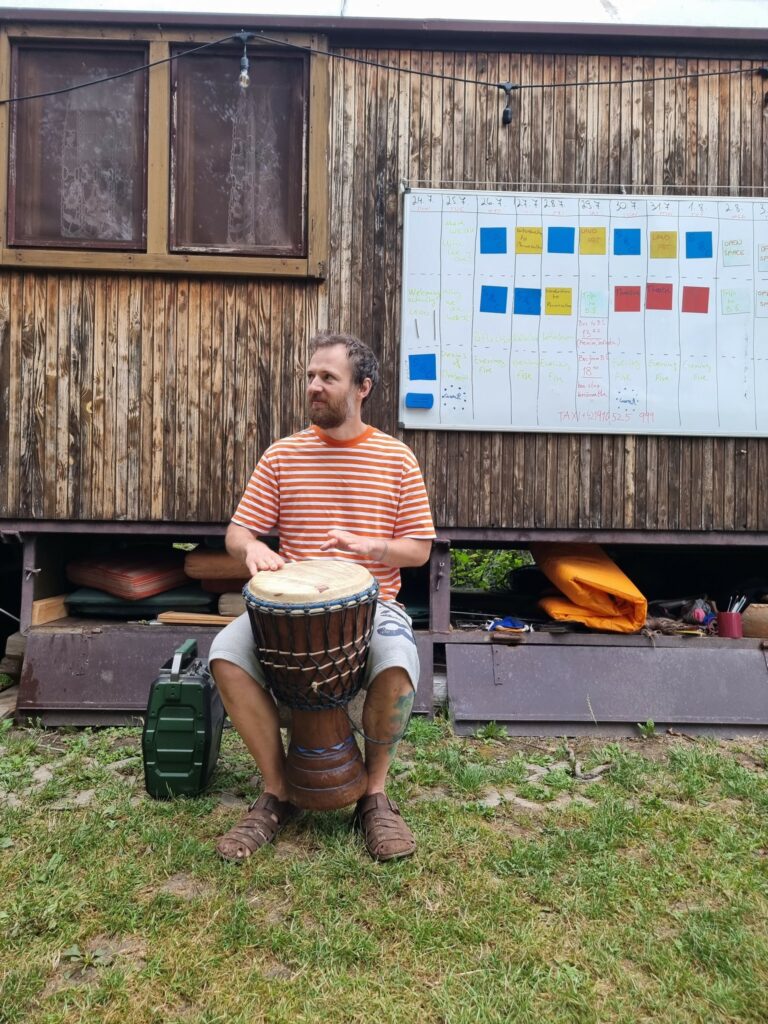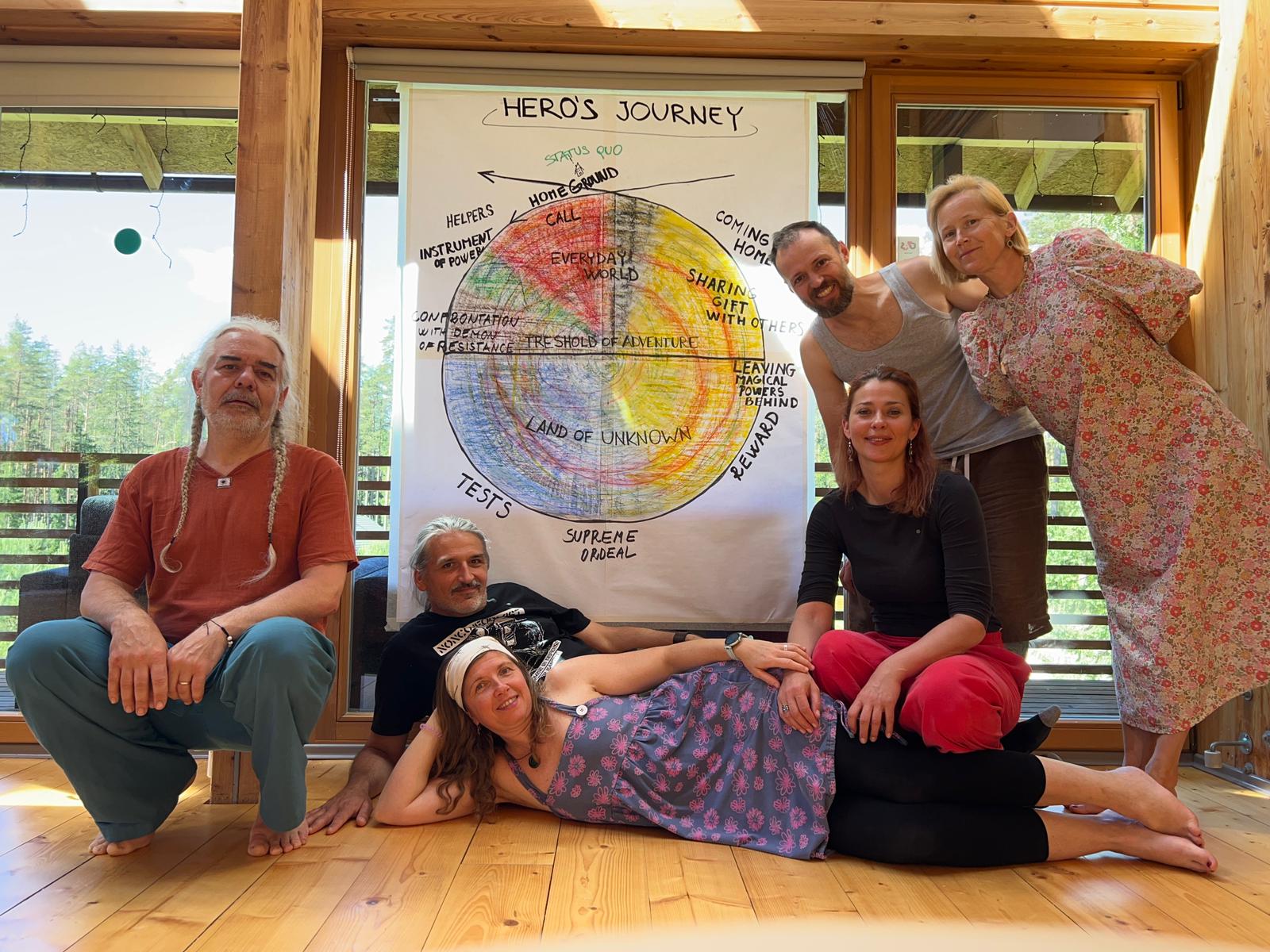
In June 2026, we followed up on the international project The Hero’s Journey in Youth Work, which we previously featured on our website. This time, the training took place in a new setting—the natural surroundings of Taevaskoja in southern Estonia—and brought together a new international group of participants. The follow-up project was entitled Journeys of Transformation: Art-Based Methods for Youth Workers.
The twelve-day training brought together 24 youth workers and six trainers and facilitators from Estonia, Czechia, Spain, Italy and Slovakia. They came from diverse professional backgrounds, including theatre, education, community work, psychology, coaching and social services. Both the new location and the composition of the group introduced fresh experiences, questions and professional perspectives into the established methodology.
The Hero’s Journey once again provided the basic framework for the training. Known from myths and stories across different cultures, it can also be understood as a map of human experience: leaving familiar surroundings, encountering uncertainty and obstacles, discovering inner resources and returning with an experience that can help us move forward in life.
Participants did not explore the methodology only in theory. They experienced its individual stages through storytelling, theatre and movement exercises, work with images and symbols, guided imagination, writing, individual reflection and sharing in small groups. Throughout the training, they also used a workbook in which they recorded their experiences, questions and professional observations.
An important topic was safety when using deeper experiential methods. The training opened a professional discussion about the relationship between non-formal education, artistic and experiential work, and the framework of clinical psychotherapy. Participants discussed voluntary participation, personal boundaries, the right to opt out of a particular exercise, the facilitator’s responsibility and the need to adapt methods to the experience and current needs of the group.
The aim was not to prepare participants to reproduce the entire process mechanically. More importantly, they were encouraged to understand the purpose of each method and select those suitable for their own practice. Elements of the Hero’s Journey can therefore be used in theatre groups, schools, youth centres, community activities and in supporting young people as they navigate periods of change.
Participant feedback also demonstrated concrete professional outcomes. Twenty-two of the 24 participants stated that they had benefited from the mobility, the same number had experimented with or developed new learning methods, and 20 participants had improved practical skills relevant to their work.
The project also created new connections between people and organisations working across artistic, educational and helping professions. After returning home, several participants shared selected methods with their colleagues or began adapting them to the needs of their own target groups.
Journeys of Transformation was therefore not simply a repetition of the first project. The new environment and group allowed us to develop the methodology further, examine its possibilities and reflect more deeply on the conditions required for its responsible use. Once again, the project showed that the Hero’s Journey does not have to remain confined to myths and books. When facilitated with care, it can become a practical tool for articulating experiences of change, developing creativity and strengthening our ability to accompany young people without imposing ready-made answers on them.
The project was co-funded by the Erasmus+ Programme.
Related Posts